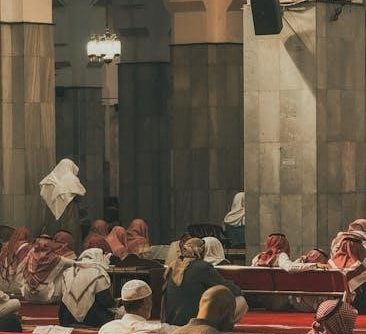
Islam, often explored through illustrated guides, aims to clarify its tenets for non-Muslims, offering insights into its history, practices, and the Quran.
These resources, like those by Ibrahim, Bokhari, and Seddon, utilize visuals to enhance understanding of this global faith and its rich cultural heritage.
The Purpose of this Illustrated Guide
This illustrated guide serves a crucial dawah purpose – intentionally introducing the core principles of Islam to individuals unfamiliar with the faith. It’s designed as a comprehensive, accessible resource, meticulously reviewed by specialists to ensure both accuracy and clarity in its presentation.
The intention is to bridge understanding, offering a clear picture of Islamic beliefs, practices, and the significance of the Holy Quran. Through vibrant illustrations – over 43 in some editions, and exceeding 500 in others – the guide aims to visually engage readers, making complex concepts more approachable. It’s a deliberate effort to dispel misconceptions and foster informed perspectives on Islam and its followers.
Ultimately, the guide strives to provide a foundational understanding, encouraging further exploration and respectful dialogue.
Target Audience: Non-Muslims
This illustrated guide is specifically tailored for individuals without a prior understanding of Islam. It’s crafted to be a welcoming introduction, avoiding jargon and presenting information in a clear, accessible manner. The intention is to reach those seeking reliable information about Islamic beliefs, practices, and cultural expressions.
The guide aims to address common questions and misconceptions, offering a balanced and accurate portrayal of the faith. It’s designed for anyone curious about Muslims, the Quran, or the historical and philosophical foundations of Islam. The inclusion of numerous illustrations further enhances accessibility, catering to diverse learning styles and making the content more engaging for a broad audience.
Essentially, it’s a resource for respectful learning and informed understanding.

Core Beliefs of Islam
Islam’s foundational beliefs encompass faith in God (Allah), angels, prophets, divine books, the Day of Judgement, and predestination – key tenets explained within guides.
The Concept of Tawhid (Oneness of God)
Tawhid, the cornerstone of Islamic belief, signifies the absolute oneness and uniqueness of God (Allah). Illustrated guides emphasize that this isn’t merely a numerical oneness, but a comprehensive unity encompassing God’s attributes, actions, and essence.
Allah is understood as the sole creator, sustainer, and judge of the universe, possessing no partners or equals. This concept rejects polytheism and any form of associating partners with God.
Guides often visually demonstrate how Tawhid permeates all aspects of a Muslim’s life, influencing worship, ethics, and worldview. It’s a fundamental principle that shapes the entire Islamic faith, stressing complete submission and devotion to the one and only God.
Belief in Angels
Islamic belief firmly establishes the existence of angels, created from light, as messengers and servants of God (Allah). Illustrated guides often depict angels as ethereal beings fulfilling specific divine duties. These aren’t deities, but rather beings completely devoted to Allah’s will.
Archangel Gabriel (Jibril) is particularly significant, responsible for revealing the Quran to Prophet Muhammad. Other angels record human actions (Kiraman Katibin), oversee death (Malak al-Maut), and intercede on behalf of believers.
Guides clarify that belief in angels isn’t about worshiping them, but acknowledging their role in God’s cosmic order and their constant interaction with the human world, reinforcing Allah’s power and knowledge.
Belief in Prophets
Islam teaches that God (Allah) communicated with humanity through Prophets, chosen individuals tasked with guiding people to the right path. Illustrated guides emphasize that these Prophets weren’t divine, but rather human beings with exemplary character, receiving revelation from Allah.
Muslims believe in all Prophets sent by God, including Adam, Noah, Abraham, Moses, and Jesus. However, Muhammad is considered the final Prophet, delivering God’s complete and final message – the Quran.
These guides clarify that accepting the Prophets is central to Islamic faith, recognizing their role in conveying God’s will and establishing a connection between humanity and the divine.
The Role of Divine Books
Islam affirms that God revealed Divine Books to various Prophets throughout history, serving as guidance for humanity; Illustrated guides explain that Muslims believe in the original scriptures revealed to Abraham (Tawrat), Moses (Zabur), David (Injil), and Jesus (the Gospels).
However, Muslims believe these earlier scriptures were altered over time. Therefore, the Quran is considered the final and complete revelation of God’s word, preserved in its original form.
These guides highlight the Quran’s central role in Islamic belief and practice, emphasizing its importance as a source of guidance, law, and moral principles for Muslims worldwide.
Belief in the Day of Judgement
Islam centers on the belief in a Day of Judgement (Yawm al-Qiyāmah), where all humanity will be resurrected and held accountable by God for their actions. Illustrated guides explain this is a core tenet, emphasizing divine justice and accountability.
Muslims believe deeds, both good and bad, are recorded by Angels, and on the Day of Judgement, individuals will be judged based on these records. Those with good deeds will enter Paradise (Jannah), while those with evil deeds will face Hellfire (Jahannam).
These guides underscore that belief in the Day of Judgement motivates Muslims to live righteous lives and strive for God’s pleasure.
Predestination (Qadar)
Islamic belief in Qadar, or divine decree, signifies that God has knowledge of all that will occur. Illustrated guides explain this doesn’t negate free will, but rather exists alongside it – a complex theological concept.
Muslims believe God’s knowledge encompasses everything, past, present, and future, yet humans are responsible for their choices. This balance is crucial; individuals are accountable for their actions, while acknowledging God’s ultimate control.
Guides often clarify that understanding Qadar fosters acceptance and reliance on God, encouraging believers to strive for the best while trusting in God’s plan. It’s a pillar of faith requiring thoughtful contemplation.

The Five Pillars of Islam
Illustrated guides detail the core duties of Muslims: faith, prayer, charity, fasting, and pilgrimage – foundational practices shaping Islamic life and devotion.
Shahada: Declaration of Faith
The Shahada, the fundamental pillar, is the sincere declaration of faith – “La ilaha illallah, Muhammadur Rasulullah” – meaning “There is no god but God (Allah), Muhammad is the Messenger of God.”
Illustrated guides emphasize this isn’t merely a statement, but a profound belief in the absolute oneness of God (Tawhid), rejecting all other deities. It signifies acceptance of Muhammad as the final prophet in a lineage including Abraham, Moses, and Jesus.
Reciting the Shahada with conviction is the entry point into Islam, and it forms the basis of a Muslim’s entire worldview. Visual aids often accompany explanations, clarifying its significance and the commitment it entails for believers worldwide.
Salat: Prayer
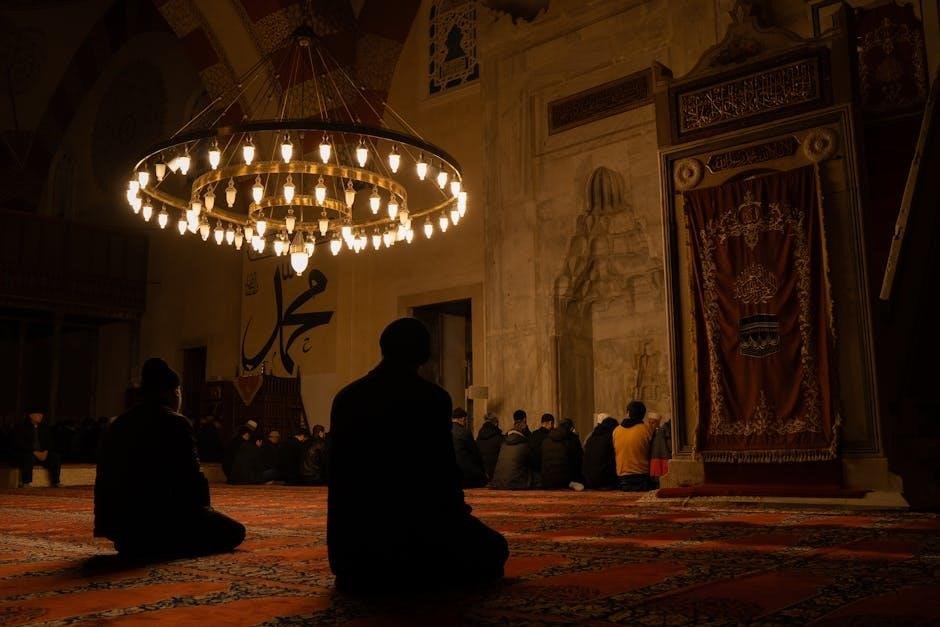
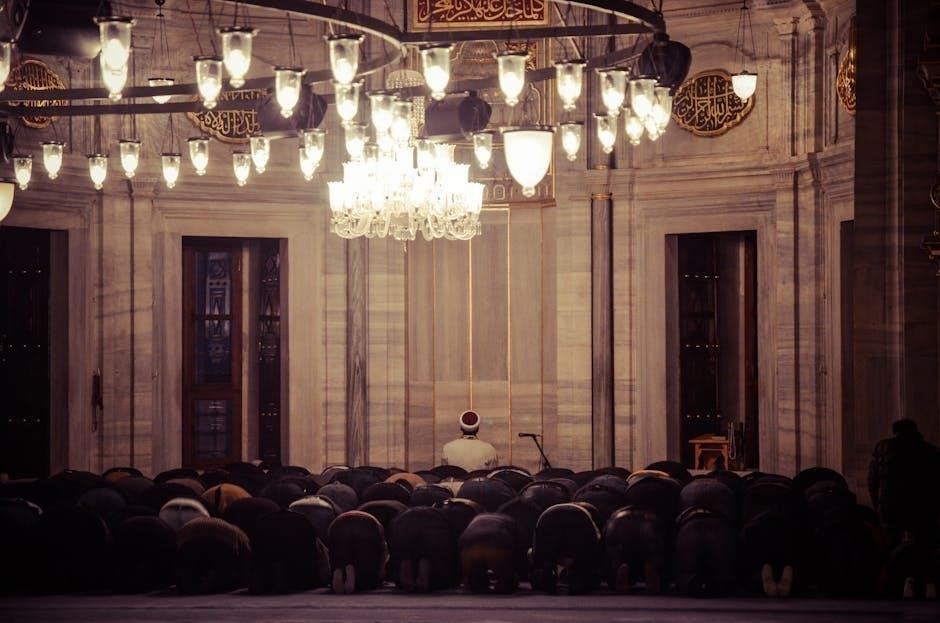
Salat, the second pillar, represents the five daily ritual prayers – Fajr (dawn), Dhuhr (noon), Asr (afternoon), Maghrib (sunset), and Isha (night). Illustrated guides often depict the precise postures and movements involved, emphasizing their spiritual and physical discipline.
Prayers are performed facing the Kaaba in Mecca, fostering a sense of unity among Muslims globally. Salat isn’t simply a rote exercise; it’s a direct communication with God, a remembrance of Him, and a purification of the heart.
These guides clarify the importance of ritual purity (wudu) before prayer and the prescribed recitations from the Quran, offering a comprehensive understanding of this central practice.
Zakat: Charity
Zakat, the third pillar of Islam, is obligatory charity, a systematic giving of a portion of one’s wealth to those in need. Illustrated guides explain that it’s not merely an act of kindness, but a right of the poor upon the wealthy.
Typically, Zakat is 2.5% of accumulated wealth exceeding a minimum threshold (nisab), distributed to specific categories like the poor, needy, debtors, and travelers. These guides often detail eligible recipients and acceptable forms of wealth.
Zakat purifies wealth, fosters social justice, and strengthens community bonds. It’s a crucial mechanism for wealth redistribution and economic equity within the Islamic framework.
Sawm: Fasting during Ramadan
Sawm, or fasting during the month of Ramadan, constitutes the fourth pillar of Islam. Illustrated guides clarify it involves abstaining from food, drink, and other physical needs from dawn until sunset.
This practice isn’t simply deprivation; it’s a spiritual discipline fostering empathy for the less fortunate, self-control, and increased devotion to God. Exemptions exist for those who are ill, traveling, pregnant, or breastfeeding.
Ramadan culminates in Eid al-Fitr, a joyous celebration. Guides often depict the communal iftar (breaking of the fast) meals and the heightened focus on prayer and charity during this sacred month.
Hajj: Pilgrimage to Mecca
Hajj, the fifth pillar of Islam, represents a pilgrimage to Mecca, Saudi Arabia, obligatory for all physically and financially capable Muslims at least once in their lifetime.
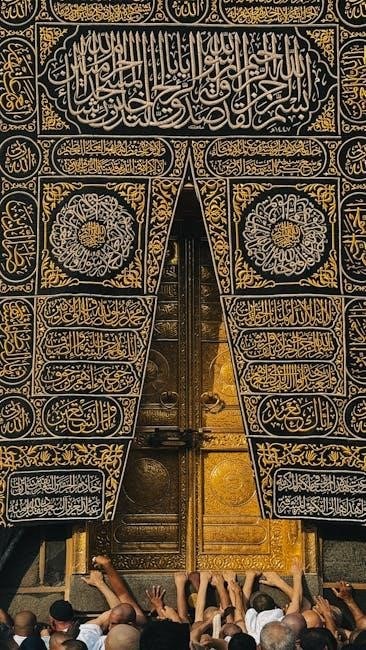
Illustrated guides detail the rituals performed over several days, including circling the Kaaba, praying at Mount Arafat, and symbolically stoning the devil at Mina. These visuals help non-Muslims understand the significance of each act.
Hajj is a deeply spiritual journey fostering unity and equality among Muslims from diverse backgrounds. Guides often showcase the immense crowds and the profound sense of devotion experienced during this transformative pilgrimage.
Islamic History
Islamic history, detailed in illustrated guides, spans from Prophet Muhammad’s life to the rise of empires, showcasing a rich legacy of culture and learning.
The Life of Prophet Muhammad (PBUH)
Prophet Muhammad (PBUH), central to Islam, was born in Mecca around 570 CE. Illustrated guides often begin with his life, detailing his early years and the challenges he faced. These resources highlight his role as the final prophet in a lineage including Abraham, Moses, and Jesus.
The guides explain his receiving of divine revelations, beginning around 610 CE, which form the basis of the Quran. They illustrate his efforts to spread the message of Tawhid (the oneness of God) amidst opposition, leading to the Hijra – the migration to Medina in 622 CE.
These illustrated accounts also cover his leadership in Medina, the establishment of the first Muslim community, and his eventual return to Mecca, peacefully conquering the city and establishing Islam as a dominant force in Arabia. Understanding his life is foundational to grasping Islamic beliefs and practices.
The Early Caliphate
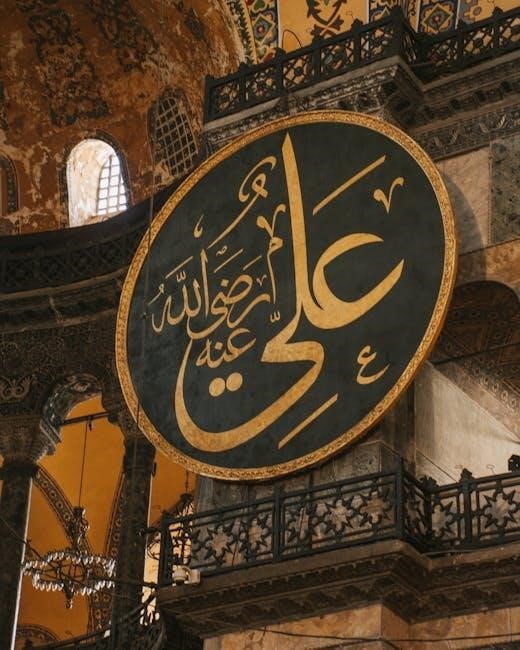
Following Prophet Muhammad’s (PBUH) death in 632 CE, the Early Caliphate emerged, guided by his successors – the Rashidun (Rightly Guided) Caliphs: Abu Bakr, Umar, Uthman, and Ali. Illustrated guides detail this period of rapid expansion, showcasing the spread of Islam beyond Arabia into regions of the Byzantine and Sasanian Empires.
These resources illustrate the administrative and military achievements of the Caliphs, including the compilation of the Quran into a standardized text under Uthman. They also address the internal challenges and conflicts that arose, particularly during Ali’s Caliphate, leading to the First Fitna (civil war).
Understanding this era is crucial, as it laid the groundwork for subsequent Islamic empires and shaped the early development of Islamic law and governance, as often depicted in comprehensive illustrated guides.
The Golden Age of Islam
The Golden Age of Islam, roughly from the 8th to the 13th centuries, witnessed an unprecedented flourishing of intellectual, scientific, and cultural achievements. Illustrated guides highlight this era’s advancements in mathematics (algebra), astronomy, medicine, and philosophy, often building upon Greek and Indian knowledge.
Baghdad, under the Abbasid Caliphate, became a global center of learning, housing the House of Wisdom – a library and translation institute. These guides showcase the contributions of scholars like Ibn Sina (Avicenna) and Al-Khwarizmi, whose works influenced European thought.
Islamic art, calligraphy, and architecture also reached new heights, beautifully illustrated in comprehensive resources, demonstrating a vibrant and sophisticated civilization.
Islamic Empires and Dynasties
Following the early Caliphate, numerous Islamic empires and dynasties shaped the course of history. Illustrated guides detail the Umayyad, Abbasid, Ottoman, Mughal, and Safavid empires, each leaving a distinct cultural and political legacy.
These resources often visually represent the geographical expanse of these empires, stretching from Spain and North Africa to the Indian subcontinent and Southeast Asia. They highlight the diverse administrative systems, legal codes, and artistic styles that characterized each dynasty.
Understanding these empires is crucial for grasping the historical context of Islamic civilization and its interactions with other cultures, as presented in comprehensive illustrated guides.
Islamic Culture and Arts
Islamic culture thrives through calligraphy, architecture, art, music, and literature – beautifully showcased in illustrated guides, revealing intricate designs and traditions.
Islamic Calligraphy and Illumination
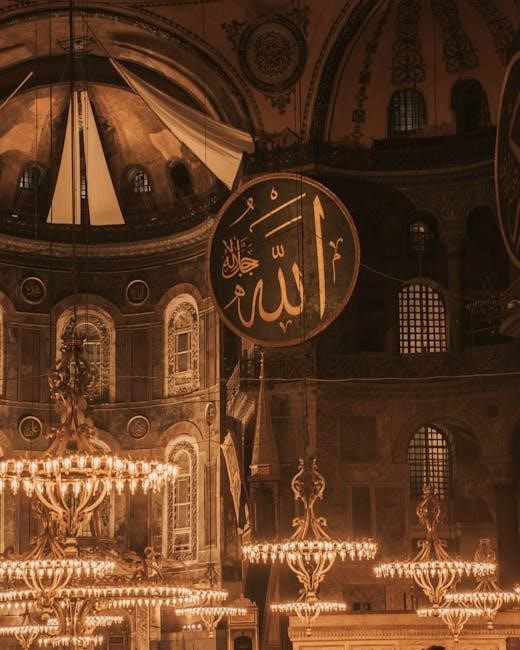
Islamic calligraphy holds a revered position, transcending mere writing to become a highly esteemed art form deeply intertwined with the faith. Illustrated guides beautifully demonstrate how Arabic script is elevated through intricate designs and masterful execution;
These guides showcase the diverse styles – Kufic, Naskh, Thuluth – each possessing unique characteristics and historical significance. Illumination, or tazhib, further enhances the aesthetic appeal, employing gold leaf and vibrant colors to adorn manuscripts and architectural elements.
The artistic expression isn’t simply decorative; it’s a spiritual practice, often used to transcribe verses from the Quran. Illustrated resources highlight the meticulous detail and profound symbolism embedded within each stroke, offering a visual understanding of this sacred art.
Islamic Architecture (Mosques, Palaces)
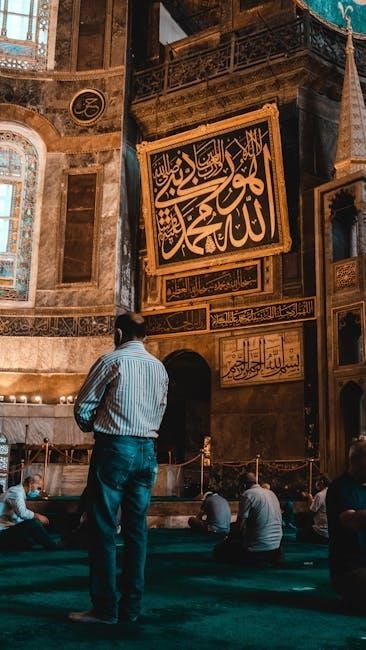
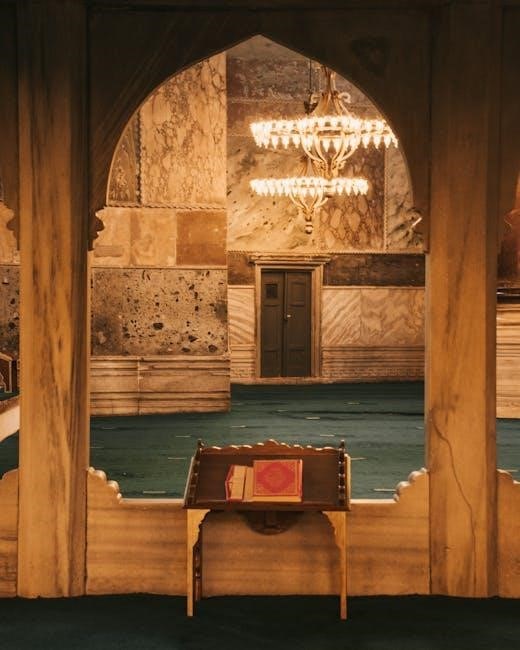
Islamic architecture, as presented in illustrated guides, reveals a stunning blend of functionality and artistic expression, deeply rooted in cultural and religious principles. Mosques, central to Muslim life, showcase iconic features like minarets, domes, and mihrabs (prayer niches), often adorned with intricate geometric patterns and calligraphy.
Beyond religious structures, palaces exemplify opulence and power, demonstrating sophisticated engineering and design. These guides highlight the use of courtyards, gardens, and elaborate ornamentation, reflecting a harmonious relationship with nature.
The visual resources demonstrate how regional styles – Ottoman, Mughal, Persian – influenced architectural designs, creating a diverse and breathtaking landscape of structures that embody Islamic civilization’s artistic achievements.
Islamic Art and Geometric Patterns
Islamic art, frequently showcased in illustrated guides, distinguishes itself through a remarkable emphasis on geometric patterns and arabesques, reflecting a profound mathematical and spiritual understanding. Avoiding figural representation in religious contexts, artists masterfully developed complex, repeating designs that symbolize the infinite nature of God.
These patterns, found in mosques, palaces, and illuminated manuscripts, demonstrate sophisticated mathematical principles and a keen aesthetic sensibility. The guides highlight the use of tessellations, symmetries, and intricate floral motifs.
Calligraphy, considered the highest form of artistic expression, is seamlessly integrated into these designs, further enriching the visual experience and conveying divine messages.
Islamic Music and Literature
Islamic literature, as presented in illustrated guides, boasts a rich tradition spanning centuries, encompassing poetry, prose, and scholarly works. From the lyrical verses of Rumi to the historical chronicles of Islamic empires, the literary landscape is diverse and profound.
Islamic music, while often less visually represented, plays a vital role in religious ceremonies and cultural expression. It frequently features melodic improvisation (maqam) and rhythmic complexity, often accompanying devotional practices.
These guides emphasize how both art forms reflect core Islamic values, such as spirituality, beauty, and the pursuit of knowledge, contributing significantly to the broader Islamic cultural heritage.
The Holy Quran
The Quran, central to Islam, is presented in illustrated guides detailing its revelation, compilation, structure into Surahs, and core teachings for understanding.
Revelation and Compilation
The Holy Quran wasn’t revealed all at once, but gradually to Prophet Muhammad (PBUH) over approximately 23 years, beginning in 610 CE. These revelations, received through the Angel Gabriel, were initially memorized and recited by the Prophet and his companions.
As the Muslim community grew, the need for a written record became paramount. During the Prophet’s lifetime, scribes recorded verses on various materials like palm leaves, stones, and animal hides. Following the Prophet’s death, during the caliphate of Abu Bakr, a comprehensive collection was initiated.
This monumental task was largely completed under the third Caliph, Uthman, who commissioned a standardized version based on the existing memorized recitations and written fragments. This standardized copy, ensuring textual integrity, became the foundation for all subsequent Quranic manuscripts, preserving the divine message for generations.
Structure and Chapters (Surahs)
The Quran is meticulously organized into 114 chapters, known as Surahs, varying significantly in length. These Surahs are further divided into verses, called Ayahs. The arrangement isn’t strictly chronological; rather, it generally follows a descending order of length, with longer Surahs appearing earlier in the text.
The initial Surahs, often longer, address fundamental theological concepts and narratives. Later Surahs tend to be shorter, focusing on legal and ethical guidelines. Each Surah has a unique name, often reflecting a key theme or prominent element within its content.
Understanding this structure is crucial for comprehending the Quran’s flow and interconnectedness. The 30 Juz’ (parts) facilitate recitation and memorization, making the Quran accessible for regular engagement and study by Muslims worldwide.
Key Themes and Teachings
Islam’s core teachings revolve around Tawhid – the absolute oneness of God – and submission to His will. The Quran emphasizes justice, compassion, and moral responsibility, guiding believers towards righteous conduct in all aspects of life;
Central themes include the importance of worship, remembrance of God, and striving for excellence in character. The concept of accountability on the Day of Judgement motivates ethical behavior and social responsibility.
Illustrated guides highlight the Quran’s narratives of prophets, offering moral lessons and reinforcing the belief in divine guidance throughout history. Emphasis is placed on family values, community welfare, and peaceful coexistence with others, reflecting Islam’s holistic worldview.
Understanding Islamic Practices
Islamic practices, detailed in illustrated guides, cover daily life aspects like Halal dietary laws, family ethics, and moral principles for believers.
Halal and Haram (Permitted and Prohibited)
Halal and Haram represent core principles guiding Muslim life, defining permissible and prohibited actions, foods, and behaviors. Illustrated guides dedicated to understanding Islam often dedicate sections to clarifying these concepts for non-Muslim audiences.
Halal encompasses not only dietary guidelines – specifying lawful animal slaughter and prohibiting pork and alcohol – but also extends to financial dealings, personal conduct, and even cosmetics. Conversely, Haram denotes everything forbidden, encompassing practices like gambling, interest-based transactions (riba), and dishonest dealings.
These illustrated resources frequently explain the rationale behind these classifications, rooted in the Quran and the Sunnah (teachings and practices of Prophet Muhammad). Understanding Halal and Haram is crucial for Muslims striving to live a life aligned with divine guidance, and these guides aim to demystify these concepts for those unfamiliar with Islamic law.
Islamic Family Life
Islamic family life, often depicted in illustrated guides, emphasizes strong familial bonds, respect for elders, and the importance of raising righteous children. These resources aim to clarify Islamic perspectives on marriage, divorce, and the roles within a family unit for non-Muslims.
Marriage in Islam is considered a sacred contract, promoting love, mercy, and companionship. Guides often illustrate the rights and responsibilities of both spouses, emphasizing mutual respect and cooperation. The upbringing of children is a shared duty, prioritizing education, moral values, and religious instruction.
Illustrated guides also address sensitive topics like divorce, outlining Islamic procedures and emphasizing reconciliation as a preferred outcome. They showcase the Islamic emphasis on maintaining family ties and providing support for all members, fostering a compassionate and harmonious environment.
Islamic Ethics and Morality
Islamic ethics and morality, as presented in illustrated guides, center around principles of justice, honesty, compassion, and accountability. These resources aim to elucidate the Islamic worldview on ethical conduct for non-Muslim audiences, showcasing a comprehensive moral framework.
The Quran and the teachings of Prophet Muhammad (PBUH) serve as the primary sources for Islamic ethics, emphasizing the importance of treating others with kindness, fairness, and respect. Guides often illustrate core values like truthfulness, trustworthiness, and fulfilling promises.
Furthermore, Islamic morality extends to all aspects of life, including business dealings, social interactions, and environmental stewardship. Illustrated guides highlight the Islamic emphasis on social responsibility, charitable giving, and striving for the betterment of society, promoting a virtuous and ethical lifestyle.